
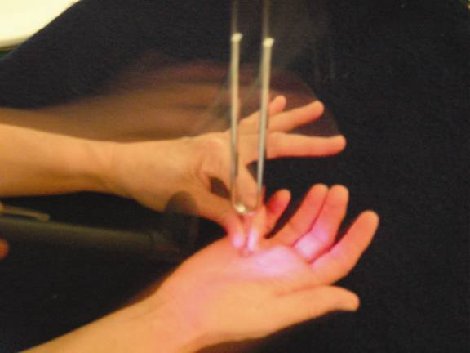
Sound Therapy: "treatment based on the finding that human blood cells respond to sound frequencies by changing color and shape, and the hypothesis that therefore sick or rogue cells can be healed or harmonized by sound. The therapy was developed and researched by French musician and acupuncturist Fabien Maman.”
French musician/composer, acupuncturist, researcher and "bioenergetician," Fabien Maman is the founding father of vibrational sound therapy.
In 1977, as an acupuncturist, he pioneered the elegant, non-invasive technique of using tuning forks and color lights on acupuncture points instead of needles.
Click here for Testimonials
"Fabien Maman is certainly a pioneer of vibratory medicine …
As an acupuncturist, I found the association of tuning forks and acupuncture to be amazingly powerful without using needles….His genius idea is that the tail of the tuning fork transmits the vibration to the meridian, cell and DNA, while the resonance of the fork itself, (the other end) transmits the same message to the counterpart of the meridian - the energy field, in order to erase the source of the negative patterns, which, over time, can duplicate in the physical body.
This is such a brilliant idea!
When Fabien went to China in 1996, in Quin Huang Dao, Master Pang Ming's center of chi-gong and acupuncture, to present his chi-gong and tuning fork techniques, one of the teachers burst into tears, saying: "how come we Chinese never thought about that! You understand more about Chinese medicine than we do!"
Click here for Testimonials
"….originally a jazz musician, [Fabien Maman] was attracted to the OOriental martial art of Aikido, and was able to study with Sensei Nakazano in Paris, France many years ago [1975]. While studying with this famous Japanese master, he also undertook study of Nakazano's system of acupuncture, based on the classical Nan Jing style. Combining his love for music with the classical approach to acupuncture channels and the art of meridian balance, Fabien Maman developed a method of treating acupuncture channel imbalances with various tuning forks and overhead chimes.
This original approach…has become the inspiration for many other teaachers exploring the use of sound on healing ...
Applying sound therapy to acupuncture theory is a perfect match. Classical acupuncture texts such as the Nei Jing (oldest existent copy from 173 BC) and the Nan Jing (180 AD) describe in detail the relationship of acupuncture channels and points to regulating the health of the human body.
Subsequent clinical practice (as well as modern research) has verified the fundamental truths of this marvelous system. It is probable that ancient Chinese were aware of the effects of musical notes on the acupuncture network, although this material does not survive in a clinically applicable method.
Fabien Maman has truly done something unique and possibly beneficial to modern society in a way as yet unknown: he has created a system of clinical application of music and musical notes to affect the health and well-being of the human body, mind and spirit ...
For nearly 30 years, Fabien Maman has created research and practical applications to balance the body, mind and spirit through the subtle energy fields. He has created more than 30 techniques through his Academy, each of which took nearly seven years to test and apply. He is in the process of developing at least 20 more.
Tama-Do Academy currently offers the following Fabien Maman tuning fork techniques in Level I:
Tuning Forks on Acupuncture Command Points (Shu Points) and Diagnosis
The Musical Spine
Tuning Forks on Subtle Body Command Points (8 Qi Mo)
Click here for Course Descriptions
Fabien Maman has also developed additional tuning fork techniques including:
Tuning Forks on the Ear
Tuning Forks on the Hands and Feet
Tuning Forks for the Face
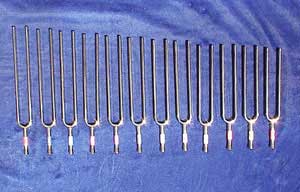
Based on Fabien Maman's exacting research, Tama-Do offers a set of 12 custom-made tuning forks made of the highest quality steel. These forks, tuned to the chromatic scale of A=220HZ, are an octave lower than standard tuning forks used to tune musical instruments. This gives deeper and longer lasting resonance on the physical body. It also guarantees stability of sound which is required to achieve the precise intervals Fabien Maman uses to empower the acupuncture points, organs, chakras and subtle body command points.
Fabien Maman’s sound/cellular research linked with acupuncture indicates that any tuning fork modality, (or, for that matter, any sound modality used for healing) must be grounded in a coherent musical scale based on Classical music traditions.
Coherence between notes leads to harmony. Incoherence leads to chaos. This is extremely important to remember when choosing your tuning forks for vibrational sound healing.
What this means, is, that Fabien Maman’s set of 12 forks are tuned perfectly to the chromatic scale of the piano. And his sound/cellular research has matched these 12 notes perfectly with the 12 main organs of Chinese medicine and Acupuncture. This means that there is a mathematical relationship between each note. And it is in this relationship, (between the notes, so to speak), that sound healing can occur.
It is important to note that all of Fabien Maman’s work in Tama-Do Academy is grounded in the Classical traditions of Music Theory, Mathematics, Chinese Medicine, Aikido, Kototama and Astrology. Each of his more than 30 techniques took at least seven years to test and apply.
Fabien Maman’s Classical Tuning Forks use the Chromatic Scale from a piano:
C C# D D# E F F# G G# A A# B
Each of these notes, according to Fabien Maman’s sound/cellular research, correspond perfectly with the 12 major organs in Chinese Medicine and Acupuncture.
Based on Fabien Maman's exacting research, Tama-Do offers a set of 12 custom-made tuning forks made of the highest quality of stainless steel, tuned to the chromatic scale of A=220HZ.
A: Tama-Do's Tuning Forks are tuned an octave below the standard A=440HZ, used to tune pianos. This gives the forks a deeper resonance and a vibration that lasts longer on the body.
A: The finest grade of stainless steel.
A: Aluminum is cheaper, but it does not hold the vibration when the fork is placed on the physical body.
A: Somewhat. But the vibration from stainless steel forks on the body is superior. The pitch is more exact with stainless steel, and the resonance lasts longer on the physical body.
A: According to Fabien Maman's research, there are twelve exact notes for the twelve Acupuncture meridians, each of which correspond to an organ or viscera within the human body. The fundamental pitch of each meridian was corroborated by the research conducted by French Physicist Joel Sternheimer, who discovered the sound frequencies of elementary particles, "music of the molecules".
According to Sternheimer, the fundamental note of an organ and the interval between the acupuncture point and the organ never varies. To be most effective, the pitch of the tuning fork must be in perfect resonance with the fundamental note of the organ. Likewise, the musical interval used to tonify or sedate the point of the organ, must be the perfect interval, to be the most efficient. The only way to gain this precision is with stainless steel tuning forks.
A: Tama-Do's twelve tuning forks use a precise chromatic scale. It is important to note that these forks are custom-made from a single batch of steel, to guarantee that the intervals between each pitch are perfect.
A: A chromatic scale guarantees the perfect pitches needed for the twelve notes of the twelve acupuncture meridians. It also provides the perfect stability of scale (both mathematic and energetic) to achieve the precise musical intervals used to tonify and sedate each point.
A: Planetary notes are a different system - not to be confused with acupuncture. If you are working on the physical body, with the physical acupuncture meridians and the organs, it is best to use the fundamental notes of the organs, as discovered by Fabien Maman and corroborated by Joel Sternheimer. Your work will be more efficient.
The planetary notes used in tuning forks were decided upon based in one frozen moment in time. A mathematical calculation, based on the relation of the planet to the earth, was made to determine which pitch was to be used for which fork of which planet.
The problem with this theory, as Sternheimer points out, is that planets move; and as they move, they immediately create another vibratory relation to the earth. The note chosen will no longer be correct.
This may be fine for some purposes off the body … but if you are tryiing to empower the acupuncture meridians and the organs with certain notes, it is far more effective to use the notes of the organ - which is constant - rather than notes of the planets - which are never stable.
A: Fabien Maman's research is based on the theory that 'blockages in our subtle energy fields can result in physical illness if they are allowed to crystallize, and Sound, Color and Movement® are the most effective tools we can use to dissolve these negative energetic patterns."
Click here for more About Fabien Maman
He has found that for tuning forks to have a durable effect in the physical body, you must associate color with sound. While the tail of the tuning fork transmits vibration into the meridian, cell and DNA, the light wheel empowers the vibration by "holding the energy field" around the fork. And, likewise, while the other end of the tuning fork resonates in the subtle energy fields, the color lights work to enhance the sound vibration, helping to clear negative blockages in the Aura.
A: The Tama-Do Color Light Wheels use color that are the vibrational equivalency of the color spectrum discovered by Darius Dinshah.


